Showing posts with label Boston 2012. Show all posts

Jul 4, 2012

Dialogues in Medicine: Physicians and Patients on 200 Years of Progress

On June 22, 2012, a glorious morning, I woke up at 6 to dress up for the conference. My host's future son-in-law had warned me about dressing appropriately for the occasion, and was aghast I did not bring a tie (I didn't want to look like a salesperson instead of a medical student, and I paid 2 months' salary for my ticket anyway!) He was nice enough to lend me his Kenneth Cole black tie but I decided not to put it on until I am positive everyone has a tie.
Which they didn't. Some even came in scrubs so I was positive I am not too shabby by comparison.

Joseph B. Martin Conference Center at Avenue Louis Pasteur

The reception area. Essay winners were received at the 3rd floor rotunda for a warm welcome by editor-in-chief Dr. Drazen

The conference hall itself, which sits 450 people, in preparation for the HIV/AIDS panel


Possibly worth all the time and money - a picture with editor-in-chief of the NEJM Dr. Drazen. I did tell him the picture will end up in application for travel money from school.

The editors were very friendly and readily talks with students or residents during the breakfast. Of course most American students were so excited given the opportunity. I later learned many whom attended breakfast that day were leaders in their respective fields of medicine and holds an editing post in the journal as well.
At 9 sharp the bell rang for start of lessons the conference started with HIV/AIDS. I won't bore you with the littlest details and contents because you can find them here (upload still in progress), so I will just give a short summary on each panel.
In HIV/AIDS we discussed how patients, mainly gay men in Los Angeles, San Francisco, and New York at the start of the epidemic, fought for medical attention. These movements gave birth to the current National Institute of Health, highly active antiretroviral therapy (HAART), and preventive measures which made HIV a manageable chronic disease today.
The maternal and fetal health panel boasted on how regular antenatal examination and improved nutrition had improved women's health tremendously, but addressed high rate of preterm birth in the United States. That abortion should be legalized and women empowered in family planning to prevent incidences of preterm labor, low birth weight infants, and poor maternal health.
The third panel, breast cancer, discussed how the invention of the randomized controlled trials (RCT) improved medicine and surgery. Patients diagnosed with breast cancer nowadays don't have to endure disfiguring surgery with terrible side effects thanks to physicians proving "more is not necessarily helpful" in cancer surgery. Today, treatments are individually tailored and like HIV, many cancer patients are managing their disease just like hypertension.
The last panel, cardiovascular disease, is about how current technology changes the percept and treatment of a once fatal disease. Hypothermia therapy, ECMO, artificial heart, are major but expensive advances during the last decade. In terms of disease prevention and management, a simple aspirin reduces heart disease by many folds, as well as cheap antihypertensives and good glycemic control. At the end of the day, all diseases can be managed and lived with thanks to technology, investments, and innovation in pharmacologic intervention.
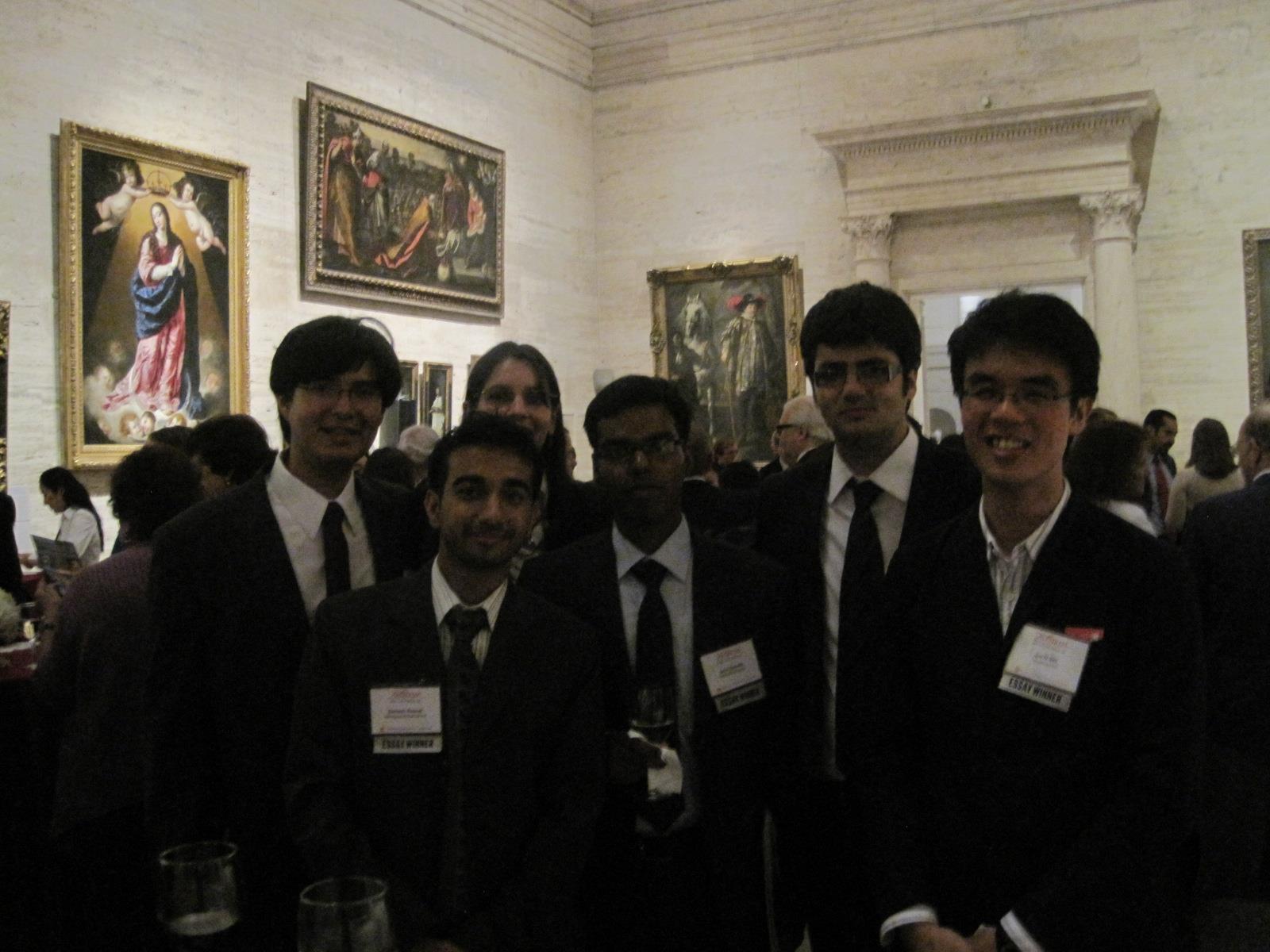
After a tiring day, the after-conference continues at the Museum of Fine Arts. A reception was waiting for us there with free passes into the museum. That evening was all about awesomeness, a la Neil Patrick Harris. We had a wine party inside a hall full of expensive paintings, NEJM cookies and M&Ms, a strings quartet, and permission to make as much noise as we like in a museum. A museum.

Drinks in the coat room of Museum of Fine Arts

This is one of my very rare pictures during the evening. I had some sauvignon blanc and experienced severe lightheadedness forcing me to switch to cranberry juice and sparkling water later. Such a waste of good wine!
An NEJM cookie. Very sweet both in the gustatory and literal sense

NEJM M&Ms

Needless to say I took a lot of the above for souvenirs. The cookies got all crushed on the way back, sadly.
There are a lot of people I would like to thank for making this trip possible:
Mum, Dad, and my sister - for the unrelenting support and rooting for my school when I was denied funds
Dr. Wu - for all her efforts in fighting on my behalf, in Mandarin
Dr. Chu - for her soft loan and endless words of encouragement
My intern partners and friends - for covering my absence, listening to my bi*ching about rejected funding, and my endless boasting later on
Sister Yang and family - for taking me in like her own son, and the Charlie Card ride, and the tie, and the coconut cake, and the endless wait at Boston Logan.

Jun 27, 2012

Boston Revisited

I had been to Boston last year: read here and here. And since time is really short this time round, I told my host I didn't have any expectations for visits and that they should just utilize me for housework and laundry, and spare me one day for the conference.
They were nice enough to empty an afternoon for some sightseeing.
Things didn't start off too well. We were delayed by an hour departing from Tokyo Narita International Airport. Culprit: "paperwork" according to captain of American Airlines flight 154.

AA flight 154 operating Tokyo Narita-Chicaho O'Hare-Boston Logan

The delay resulted in us Boston passengers missing our connection. We were rebooked on a much later flight, which I managed to standby onto an earlier one. My baggage, however, couldn't make it and were sent to me only the following morning.


Boston Public Library

And her beautiful courtyard 

MIT and me wearing pyjamas (my baggage didn't come until 10 in the morning)


The following day on the way to the conference I passed by the entrance of Boston Children's Hospital - one of the best children's hospital in the States if not the world.

It must be every (aspiring) pediatrician's dream to be working in here, including me

I will save the conference itself for another post. 

Fast forward to leaving Boston. This is Japan Airlines flight 007 operating Boston Logan to Tokyo Narita. The Boeing 787 is fresh from the factory and a very impressive machine to fly in, despite it still being a pressurized metal (and carbon fiber) tube.


Coming up next: the 200th anniversary conference Dialogues in Medicine

Jun 20, 2012

There and Back Again

Considering I'm not "there" yet, "back again" is not totally appropriate at the moment. Barely 3 weeks after starting my intern year, I'm taking a week off, traveling halfway around the world, and incurred debt before my first salary.
Life as an intern is more demanding than the placid medical student we got really used to. However we're not on full force yet as Ob/Gyn rotation is not yet the magnum opus. More about intern life next time.
I am about to board the first of a series of flights to Boston, a city I've been to last year. A few days ago I learned that the NEJM would stream Dialogues in Medicine, the conference I'm there for, live. This made my debt-incurring journey sounds silly. However, since the ticket is non-refundable and everything else is arranged, I might as well splurge and enjoy the cramped seats and iPhone-sized meals.
There are currently two typhoons hovering around Taiwan and Japan. Fortunately my flights have not been affected, as yet.
Will keep you guys updated on Boston as soon as I'm available. Meanwhile pray for a mild typhoon landing over Taiwan, a smooth journey ahead, and enough battery to last the 16-hour flight.

Jun 4, 2012

NEJM Scholar: Third Last Entry

Since the essay is published on their website, I figure it's time for me to share it with you guys, too. I was a little sad to find my entry to be the third last, but anyway...I welcome your comments and critics.

The Well-Informed Patient


by Jun Yi Sim, Tzu Chi University

Posted on May 24th 2012
NEJM Scholar
The ease of communication has empowered millions in obtaining and distributing information. A major consequence of social networking is the devaluation of knowledge – what used to come in textbooks and newspapers can now be obtained free via the internet. However, whether they are reliable remains a matter of the user’s background and intelligence, especially so in cyberspace.
Sadly for the general public, real, solid medical information from reputable sources are expensive. For those unwilling to pay, reliability is compromised from one-sided commercials with profits in mind. Hence, providing essential research findings to a non-medical population free of charge is a growing need. An online portal with the spirit of social networking and real-time updates will fit the niche comfortably. It will provide the highlights of recent discoveries and recommendations at no costs, invite the public discussion, and solicit improvements from feedback. It will be something between Wikipedia and Facebook.
To ensure accountability and credibility, the portal should be moderated by a panel of medical, public health, and public representatives with peer reviewers. It should be a transparent and objective group with the aim of empowering patients to make decisions. In short, it serves as the online physician providing unbiased advice albeit with real-time updates accessible anywhere.
It will differ from co-existing NIH or government health policies in instant public feedback and interaction. The gap between research and clinical practice will be narrowed with individualized recommendations for exceptional cases. Patients can also advocate for policy or funding reforms under a unified portal. Most importantly, interaction allows the medical community to align itself with the public’s needs.
A major challenge would be publishing copyrighted materials at no charge. The argument for the portal would be publishing the essentials – statistically significant figures, adverse effects, survival rates, medical or surgical indications. Publishers will benefit in the long run when patients desperately in need of details purchase full articles. In the long run, it hopes to empower people, especially those from poorer regions, with sufficient information to make their own choices and participate in trials via international collaboration. With increased feedback, we aspire to balance the inequality via global cooperation and pooled resource management.
Information and copyrights will inevitably costs very little in future – just take a look at Youtube. As the spread of knowledge deregulates, it is vital for patients to get them from a trusted source. Doctors are doing that right now, but the quality is plagued by inconsistencies across regions, language, and workload. A fair peer-reviewed portal would serve as a good second opinion with pooled patients’ input for references. Further down the road we hope to get patients involved with their needs and curiosities. It would be a compromise for journal publishers, but not without a noble cause in line with worldly trends.
We believe a well-informed patient is easier to treat and we look forward to the day when we can discuss eye-to-eye with our well-informed patient.

Apr 1, 2012

Something Awesome is Coming Up

If you follow me on Twitter, you'd have noticed some teasers release since last month.
This was followed by application for a US visa, a plane ticket, and a letter.


Many of my virtual friends took a guess in the first tweet, but as more teasers were revealed some eventually guessed it.
This year happens to be the 200th anniversary of the New England Journal of Medicine (NEJM), the oldest and most prestigious journal in medicine. As part of their celebrations, they organized an essay competition for medical students entitled:
In the last twenty years, the internet and social networking have brought profound changes in how information is communicated. How can we harness this technology to improve health?
I wrote a 500-word essay one weekend and made my submission without thinking twice. 4 months later I received an email and we're back to the tweet above.
What I won is an invitation to a full-day conference, Dialogues in Medicine, in Harvard Medical School on June 22. Virtually everyone in the NEJM community - physicians, patients, and members of the community were invited to discuss the progress, obstacles, experiences, and future of medicine in 4 topics - HIV/AIDS, maternal and fetal health, breast cancer, and cardiology.
I had a hard time deciding whether to attend the conference. I will start my intern year in June with call nights every 3 days in addition to daily clinical work. My partners will have a hard time covering my week off, and my patient list will suffer considerable discrepancies at the end of my rotation.
After talking to numerous people and playing the "go, not go" game for a week, I decided I will take the leap. The reasoning goes as follows: I will regret it for the rest of my life if I don't go. No more arguments.
I will spend 3 days in Boston, which I had visited last summer. One day for the conference, two days to recuperate from jet lag and sightseeings. I am sure it will be another eye-opening experience for me, and as a return to my loyal readers I will try to write an account about it, as well as every tiny details during the process. So stay tuned!