Showing posts with label New York 2011. Show all posts

Aug 5, 2011

New York New York: Etched in My Mind

I'm back in Taipei and had resumed my clerkship for 5 days now. Gradually tuning my body clock 12 hours ahead and getting used to rice, tea, and cabbage. Any conversation with me usually begins and ends with New York, its people, the huge meals, and exciting urban life. As life on this side goes back on track, so does the one on the other. There are certain qualities and images that I will remember about New York, and also a few people I'd like to thank for this trip.
New York taught me how to slow things down and do it properly. Strange enough for a bustling metropolis and capital of the world, it's in New York that I learned listening to others. Sensing what they want from you, convey what you can do, and carry on. Doing things fast doesn't mean doing it right, and this is what I must learn especially when work starts to rain in future.

Relax. Listen to others.

Take time off for solitude and reflection. We don't need to be around people all day.

Don't hesitate doing what's right because others are judging you.

In other words, follow your heart and just have fun when you have the opportunity.

Life's too short to think twice about something, sometimes.

And slow down to really look at something or someone.
We're very grateful the past month for Prof. and Mrs. Ku. Prof. Ku was my Dad's teacher back in NTNU, I got to know him just before he retires back to his family in New York. Mrs. Ku showered us with exemplary Taiwanese-American hospitality, driving us to dinners, across Brooklyn Bridge, and even to the airport. Her bubbly character made us feel at home the second day in New York, and subsequently consistently pestered us with phone calls for trips and fancy restaurants. July in New York would otherwise be dull without her presence.

This is Ginger, daughter of Uncle George, CEO of Tzu Chi New York. She works at the DaAi TV office at where we lived, hosts USA 360 degrees every month (a pre-recorded English program on DaAi TV), and our housekeeper during the day. I'm keeping this photo at the deepest crevice of my computer to blackmail her when she becomes famous, which will be really soon.

With jet-lag waking us at 3am Taipei time and shutting us down 7pm, I can't help reliving the past month in between sleep and consciousness. As much as I advocate change and voice for it, I can't help believing it'll last up to the end of the year. Nevertheless, I will attempt to persevere with the lessons I learned 8000 miles away, try to stay true to myself in face of stereotypy.

Aug 2, 2011

New York New York: Sim's Little Architecture Adventure

I imagine New York would be a happy place for architecture students - the gothic baroqueness of Chrysler Building to the Greek-and-Roman inspired Rockefeller Center. For people with nil architecture knowledge like me, we just gawk in amazement and take photographs of everything. However, Manhattan being a more crowded place than most other parts of the world, a lot of these intricate designs or decorations won't fit into a camera lens on street level. What I got were mainly cliché at its extreme and some accidental stumble in an unlikely neighborhood, no intermediates in between.
Same thing with the arts, I invite you to sample New York's architecture by eyes and not through a camera lens. Starting to appreciate lines, colors, and space now that I'm stuck in Taipei's thousand hues of grey and grimy facade.


My tour starts at Wall Street, where the subway station is noticeably less gritty compared to others.

The intersection between Broadway and Wall Street is where the nation's most expensive real estate lies, currently occupied by Bank of New York. The "wall" for Wall Street originates from the Dutch, which built wooden barriers along this southerly end to defend New Amsterdam back then. Little do they know the humble wooden walls would translate to the most prestigious financial center less than a century later.


Touristy me.

New York Stock Exchange (NYSE), where as many dreams were made for as many broken. The coincidental stars and stripes is, to me, embodied the American dream in this place of unimaginable wealth and overnight bankruptcy. Interestingly, when I Googled NYSE, "stealing democracy, one billion dollars at a time" mindlessly popped up...

Federal Hall is just opposite NYSE with George Washington guarding the main entrance. Bailouts anyone?

Look for your own skyscraper shot along the way

Continue along Broadway and you'll be greeted by the new building at WTC. Due completion by early September 2011, the temporary memorial site and St. Paul's Chapel is worth a visit, just to pay respect to the 2977 souls who innocently passed and the day that changed everything.

A stone's throw away at City Hall, an exhibition of contemporary structure blends in surrounding classicism, including...

Tweed Courthouse, funded by the corrupt "Boss" Tweed constructed between 1861-72.

And Municipal Building, where Mayor Bloomberg works.

Just east of City Hall, the 19th century Brooklyn Bridge, once the longest suspension bridge in the world at nearly 2km, is the hallmark of optimism and hope, inspiring Kerouac, Marianne Moore and Bloom, which immortalizes the bridge with its explosive opening of "To Brooklyn Bridge":
"O harp and altar, of the fury fused,
(How could mere toil align thy choiring strings!)
Terrific threshold of the prophet's pledge,
Prayer of pariah, and the lover's cry,--
Again the traffic lights that skim thy swift
Unfractioned idiom, immaculate sigh of stars,
Beading thy path--condense eternity:
And we have seen night lifted in thine arms."


The United States Court House and a very important engraved message - the true administration of justice is the firmest pillar of good government.

City Council and State of New York along the way to...

Chinatown - where newly-arrived Chinese immigrants lived along the Italians at Little Italy, just a few blocks away.

SoHo - once the place to be for free and artsy souls. Now lined with high-end galleries and retail.

NYU has no campus. Or literally, a collection of inconsistent building blocks all marked by the violet torch.

My other favorite aside Strand Books, Shakespeare & Co. Needless to say they have a vast collection of plays by Mr. Shakes, and second-hand books at bargain prices too!


My host kept on telling me how NYU is not a university in truth but an urban campus. I didn't quite take it to heart until she showed me around Columbia.
Occupying the northwest corner of Manhattan, Columbia indeed has a breathtaking campus and Alma Mater sitting in front of her library.


Back to our final stops of the architecture tour. Radio City Music Hall is one of the many gems of the Rockefeller family that had become synonymous with performing arts in the US and around the world.

Rockefeller Center. "If you come during Christmas, there will be a HUGE Christmas tree at the center of the square and Josh Groban singing underneath it," my host said. There and then I decided to return in Christmas even if I fail medical school and had to smuggle myself in the cargo section of the airplane.

Finally, if you still have the energy to walk up north, Bethesda Fountain in Central Park is celebrated in "Angles in America" as a symbol of eternal health. Regardless, it is the first public art project awarded to a lady, and a true marvel of a sculpture with the serene face and wings just about to take flight.

Jul 30, 2011

New York New York: Adolescent Medicine

I'm telling you something very personal - I had a horrible time as an adolescent. What typical adolescents do I missed all, except the endless tuition classes, science projects, and striving for As in school. I was a total alien during sports, hanging out at the cool spots, and relationships. Somehow when I saw Adolescent Medicine is being offered, I wanted in. Images of a friendly doctor talking to the vain teenager about issues too embarrassed for parents and too personal for friends conjured in my mind. Somehow I wished I had one of those doctors back then.
I'm well pass adolescence now. But my blank experience didn't help when it comes to talking to American adolescence who seem to have everything in the world.
Dr. Chang and Dr. Ipp are like twin sisters managing the adolescent medicine program at NewYork-Presbyterian. They were chatty, fun, and just the sort of person I would pour my secrets to if I were an adolescent. Dr. Chang also manages a special service program on Monday afternoons which sees children from problematic families. I am humbled by the amount of patience and confidentiality she gave her patients, and the generosity she showed me by showering me with details and reading materials.


As for American adolescents, my experience with them are far away from Hollywood stereotypes of arrogance or self-bloated possessive personality. Many of them are even shy and, like Asian teenagers, blush and turn wood when we talked about sex or illicit drugs.
Teenagers here enjoy a lot of confidentiality - physicians are not allowed to disclose information even to their parents without permission provided under special circumstances. The difference in culture, attitude towards casual encounters and school are all new to me. While I read up night after night on contraception and minor's rights, I went to an eating disorder ward at Westchester, New York, and was surprised by how open-minded families are toward their child with psychiatric disease - Mum and Dad were readily talking about how the perfectionist daughter grew obsessive with calories and their future plans and confidence that everything would turn out fine. It tears me to see ill adolescents, but the family and hospital staff support here is overwhelming.
Both Dr. Ipp and Dr. Chang are very accommodating towards medical students. Dr. Chang never failed to praise anyone for their littlest effort, with "exactly!" and "excellent!" all the time; Dr. Ipp thanked us after each session and always provided feedback and motherly advice. Both to me were like older sisters in medicine which set the benchmark of how I will treat my students in future (that is, if I manage to graduate).
I'm at the end of my clerkship at NewYork-Presbyterian Hospital. The one month seemed as surreal as first stepping on American soil. Hospital environment is so familiar yet different - the morning reports, noon conference, friendly residents and medical students, attendings I shall all miss dearly. Most of all, I shall miss the multicultural, often unpredictable, but always interesting patients. Spending more time with patients and being thorough and dedicated toward their care is my goal after this elective. We might not have the American environment for training physicians, but care and attitude towards patients we can achieve.

Jul 28, 2011

New York New York: Arts and Parks

As with all major cities in the Anglosphere, New York has many great museums offering a wide palate of art tastes as well as patches of green from as small as the neighborhood playground to Central Park. Having the entire month at my disposal I had my fair share of crowding for pay-as-you-wish museum entrances and lounging in the park. One thing I would really love to do is to picnic at the park - books, shade, and home-cooked casseroles. But somehow the significant half never showed up and I'm too cowardly to picnic alone, so the dream still remains a dream.

Central Park is smack in the middle of Manhattan, an oasis of greenery, natural landscape, and water amidst the hustle and bustle of sprawling skyscrapers around it. Squirrels hop around while tourists and Manhattanites seek refuge from the big apple outside.


Central Park Zoo is smallish and charges $12 for general admissions. However, it has sea lions and penguins, guaranteed to drive the little ones crazy.

Shooting a movie in Central Park. Someday if you see me wondering aimlessly at the background of some Hollywood movie, you know it's shot at Central Park on summer of 2011.

Flushing Meadows Corona Park is one subway station away from where we live. It has an awesome steel globe and was host to the 39/40 and 64/65 World Fair (a.k.a World Expo).

Hudson River Park at southwestern Manhattan, as mentioned previously, is sunny and very gay.

Washington Square has a faux Arc d'Triumph. And being just beside NYU, a very chic place to hang out.
Central atrium of Museum of Modern Arts (MoMa). The theme for summer is urban living, portrayed by little squares of individual "windows" forming together a collage of colorful yet harmonious landscape.
MoMA offers free Friday evenings. Definitely grab anything free in capitalist America. For me, finding inner peace is easier with museums than churches or temples. Art is more than colors and brush strokes, it is a form of expression - telling the story of an instant state of mind to an entire generation using a medium so diverse from photography to calligraphy.

The con of a free-for-all is the amount of people. I'm fine with people if they behave properly and have some simple courtesy (such as not walking in front of you when you're viewing an art piece). However, most of (us) don't. And they like taking pictures of famous pictures, which is understandable. Since showing off is every human's nature - oh, I went to MoMA and saw Starry Night. But you know what? Most of the time the picture just get stashed into your Facebook album and forgotten 2 months later. So please don't hog the space around Starry Night and let others take a good look at it. You can get your photograph at the museum store for $1. And they usually do a better job than your DSLR.

I'm really curious about the psychology behind photographing the famous works. We all know our camera has flaws, yet we never stop snapping them, knowing very well the colors and composition will be way off compared to the original. Is it our nature to preserve beauty? Our desire to own beauty? If we can't have the original, why not have a photograph of it? Shamefully I did that too during my trip to France - aimlessly wasting my pixel space taking inferior pictures of art I don't even know.


What I later learned is that art exists in your heart and not your eyes. Art is what you feel and how you react when your senses are bombarded by colors, textures, light, emotions - not simply what you see and interpret from a photograph. You can look at the greatest piece of art and not feel a thing - then that is not art to you. Similarly, you can stare at the most common objects and get a torrent of emotions.
If you get what I said, repeat after me: I will not aimlessly take photographs of art in museums anymore, because it's stupid, useless, and impede other's opportunity of appreciating them.

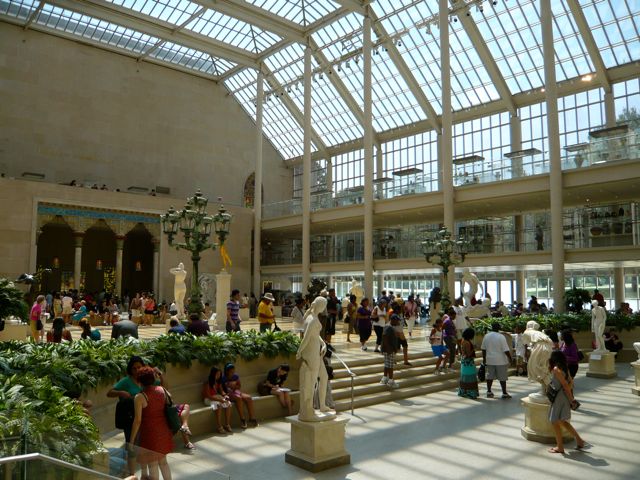
Metropolitan Museum of Arts (The Met) admits everyone by donation at any time. That means you could go in by just donating $1 even though the suggested donation is $12 for students. Extended opening hours on Fridays and Saturdays make it a nice place to spend the entire day if you're not tired of walking.

The problem with mega museums, such as The Met or the Louvre, is that their collection is so vast you can never ever see them all. To avoid feeling unsatisfied about not seeing as much as you planned, lower your expectations - choose only one or two "specialties" you wanted to see, say Nineteenth century Europe or Egyptian arts. When you arrive, don't get distracted and concentrate on your quest. If you're still feeling up to it after you're done, explore the other sections. If you wonder aimlessly like you did photographing canvases in MoMA, you get tired quickly, saw what you don't really like, and go home leaving having no impression of any specific pieces.

Since the admission is only $1, you can come back anytime again and again. That's the cool thing about The Met.


Smaller museums are nice if you, like me, can't get rid of the "must see everything" mindset. Guggenheim Museum is on my top list for its spiral architecture, pedestrian-friendly galleries, and vast exhibition spaces. Admission is by donation every Saturday from 5.45pm to closing.

Neue Galerie for German and Austrian Art gives free admission first Friday of every month from 6pm onwards. The collection is smallish but the interiors are authentically Austrian-Hungary and for psychology students, there's a 19th century Freud chair you can laze on all day.

Frick's Collection (or Museum) is actually the old residence of Henry Clay Frick, industrialist, financier, and art patron. Though much hated among his industrial colleagues, he had an enviable collection of furniture, porcelain, statues, and paintings. Many Johannes Vermeer and Rembrandt are housed here in rooms untouched since early 1900's. Admission is by donation every Sunday from 11am to 1pm, and includes a free audio guide. If you have all day, stay for the free sketch trial from 1 to 4pm, where you might just unearth the next Picasso in you.

The Frick's Garden


Much as we believe arts and parks are two vital components of any global city, Asian cities are still lagging behind. I believe art is as important as religion - in fact art originated as a medium of expression and praise for religion - that must be nurtured, promoted, and freely available. Though museum admissions (during normal hours) costs around a meal for one, more so unaffordable after the conversion, free or admission by donation hours are certainly the right way to promote social awareness and art sensitivity. There is art cells in each and every one of us. Discovering and unearthing it will only do good in the sense of better appreciation, expression and communication of emotions and feelings. Art is definitely not for art school students only, and especially for heavily scientific people like myself, art is a way of doing things mindlessly - taking an uncalculated step against all my logic and reasoning.